


Cabinet, Knesset slated to vote on appeals to ‘Citizenship Law’ next week - The Times of Israel
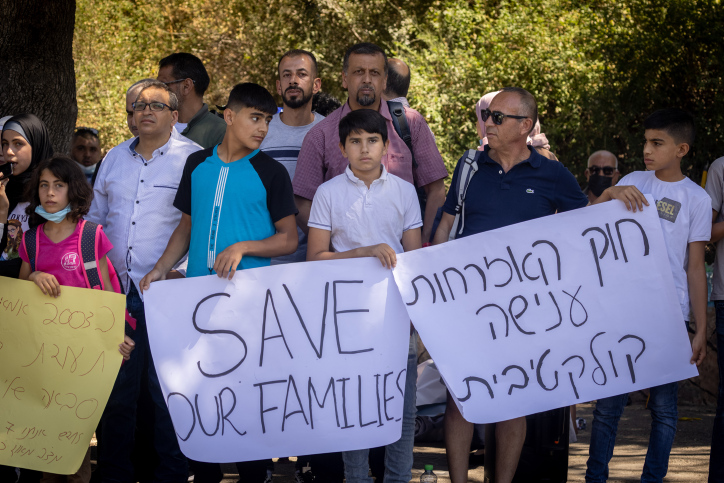
The cabinet, followed by the Knesset, is set to vote on Sunday on a series of appeals to legislation that would ban issuing permits for Palestinians who marry Israelis to live with their spouses in Israel.
The so-called “Citizenship Law” was first passed in 2003 and has been renewed every year since, until last July, when the bill expired after the coalition failed to win a vote to extend it. Interior Minister Ayelet Shaked has vowed to bring it back to the Knesset floor, and the Ministerial Committee for Legislation voted last month to advance the bill.
But the coalition’s left-wing Meretz faction attempted to hit the brakes on the legislation, filing an appeal against the bill aimed at preventing it from being fast-tracked without reforms. A second appeal was filed by Yesh Atid against a similar but more restrictive bill put forth by Religious Zionism MK Simcha Rothman of the opposition that was also advanced last month.
Rothman’s bill is seen as more likely to gain backing by the full Knesset due to its sponsor, hence the government’s willingness to advance the legislation, but it is not immediately clear which bill will move forward.
On Tuesday, Shaked announced that the appeals would be voted on by the cabinet and then the Knesset, appearing to confirm that at least one of the bills has enough support to advance. She said the activity was coordinated with Cabinet Secretary Shalom Shlomo.
“On Sunday, the government will vote on the appeals that have been submitted on the Citizenship Law, and then we will vote on them in the Knesset,” Shaked said. The minister said the legislation “has the overwhelming support of more than 100 MKs, and we cannot let politics sabotage it once again.”

While the right-wing parties in the opposition all support the legislation in principle, they voted against it last year in order to embarrass the government and attempt to fracture the diverse coalition.
The law has been wildly controversial since its inception, with rights groups charging that it discriminates against Palestinians and Arab Israelis. The Supreme Court upheld the law in a 6-5 decision in 2012 after a protracted legal battle.
Advertisement
Shaked ordered her office to continue to implement the ban despite its expiration.
But last month the Supreme Court ordered Shaked to cease enforcing the implicit ban now that the legislation was no longer in effect, saying that the law does “not allow the enforcement of a law that is no longer on the books.”
The ruling has forced Shaked to return once again to attempt to push the legislation through the cabinet and the Knesset. Several Meretz MKs have vowed not to support the bill, as have members of the Islamist Ra’am party.
In the meantime, Shaked on Tuesday publicized temporary regulations for dealing with applications for residency by Palestinians married to Israelis until the legislation can be renewed.

Under the purportedly temporary regulations, required of Shaked by the High Court ruling, her office will deal with applications according to a set of priorities, including starting with those over age 50 who are said to pose the least security risk, and couples who have already held military-issued stay permits for the past five years.
Shaked said she had hoped not to have to issue such regulations, “but unfortunately, for now, politics has overcome the need to maintain the fortification of the State of Israel as a Jewish state and the need to protect the security of the state.”
Advertisement
Around 12,700 Palestinians married to Israelis live in Israel with temporary documentation, required to constantly renew their fragile status in the country. For years, most were not permitted to drive or open bank accounts. If their Israeli spouse dies or they divorce, they could be deported — forcing their children to either leave with them for the West Bank or stay behind without them.
Around 130,000 Palestinians were granted family unification rights during the 1990s, before the ban went into effect. According to the Shin Bet security service, some 155 of those people or their descendants have been involved in terror attacks since 2001.
During a global pandemic, one tiny country is producing research that's helping to guide health policy across the world. How effective are COVID-19 vaccines? After the initial two shots, does a third dose help? What about a fourth?
When The Times of Israel began covering COVID-19, we had no idea that our small beat would become such a central part of the global story. Who could have known that Israel would be first at nearly every juncture of the vaccination story - and generate the research that's so urgently needed today?
Our team has covered this story with the rigor and accuracy that characterizes Times of Israel reporting across topics. If it’s important to you that this kind of media organization exists and thrives, I urge you to support our work. Will you join The Times of Israel Community today?
Thank you,
Nathan Jeffay, Health & Science Correspondent
Advertisement
source: https://www.timesofisrael.com/cabinet-knesset-slated-to-vote-on-appeals-to-citizenship-law-next-week/
Your content is great. However, if any of the content contained herein violates any rights of yours, including those of copyright, please contact us immediately by e-mail at media[@]kissrpr.com.