


Cabinet okays Citizenship Law for Knesset vote, over objection of Meretz, Ra’am - The Times of Israel
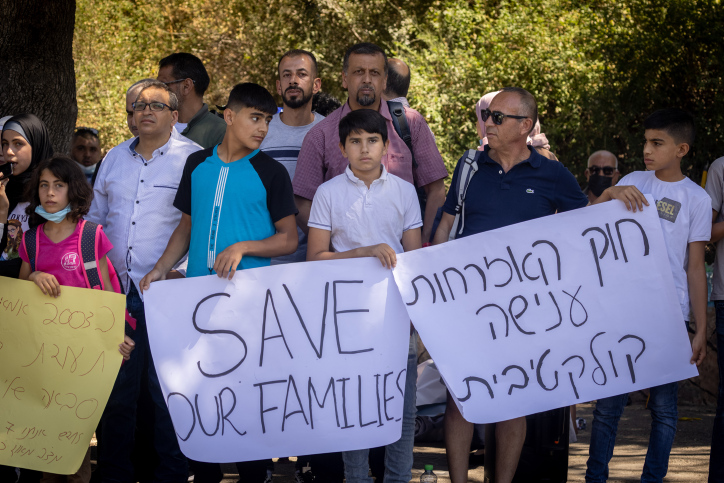
Members of the cabinet on Sunday approved the controversial so-called Citizenship Law for a vote in the Knesset plenum, despite objections from the coalition’s Meretz and Ra’am parties.
The bill is expected to be brought before the plenum this week.
If passed, the law would renew a ban on permits for Palestinians who marry Israelis to live with their spouses in Israel. The ban was first passed in 2003 and had been renewed every year since, until last July when the law expired after the coalition failed to win a vote on extending it.
Both left-wing Meretz and Arab Islamist Ra’am oppose the legislation, which they say discriminates against the Israel Arab population, and both have warned of consequences for the coalition if the government moves forward on a contentious issue while ignoring their opposition.
The coalition’s razor-thin majority in the Knesset means it needs every single member to vote on most bills in order to pass them. Interior Minister Ayelet Shaked, who is spearheading the legislation, appears to be banking on support for this bill from the opposition as well.
Meretz party chief Nitzan Horowitz called the decision “a breaking of the rules” of consensus that underpin the coalition and warned it would have “future repercussions.”

On Saturday, Horowitz warned of a “painful response” if Shaked moves forward with the bill. “It’s a racist law, a law that discriminates against Israel’s Arab citizens, a law that has no place in a democracy. We’ve said we cannot support this law,” Horowitz told Channel 12.
“Anyone who goes against the agreements must understand it will come at a price.”
Advertisement
Last month, the High Court ordered Shaked to cease her de facto ban on Palestinian spouses receiving residency in Israel, saying that she was attempting to enforce a law that expired in July. Shaked then vowed to bring the bill back to the Knesset floor.
“Over 100 members of Knesset support the bill, which is an essential one for the security of the state and for maintaining its Jewish identity,” Shaked tweeted Sunday.
A similar bill, proposed by Religious Zionism MK Simcha Rotman of the opposition, passed a vote in the Ministerial Committee for Legislation last month, allowing it to be fast-tracked through the legislative process. From there, the bill goes to the Knesset, where it must still pass three votes before becoming law.

Rothman’s bill is seen as more likely to gain backing by the full Knesset due to its sponsor, hence the government’s desire to advance its own legislation, but it was not immediately clear which bill would move forward or if the two bills would be united.
The Labor, New Hope and Blue and White coalition parties all said they would support a renewal of the Citizenship Law. Left-wing Labor party chairwoman Transportation Minister Merav Michaeli said her party supports the bill “for security reasons” but noted that “the problems that the bill raises cannot be ignored.”
While the right-wing parties in the opposition all support the legislation in principle, they voted against it last year in order to embarrass the government and attempt to fracture the diverse coalition.
Advertisement
The law has been wildly controversial since its inception, with rights groups charging that it discriminates against Palestinians and Arab Israelis. The Supreme Court upheld the law in a 6-5 decision in 2012 after a protracted legal battle.
Around 12,700 Palestinians married to Israelis live in Israel with temporary documentation, and are required to constantly renew their fragile status in the country. For years, most were not permitted to drive or open bank accounts. If their Israeli spouse dies or they divorce, they could be deported — forcing their children to either leave with them for the West Bank or stay behind without them.
Around 130,000 Palestinians were granted family unification rights during the 1990s, before the ban went into effect. According to the Shin Bet security service, some 155 of those people or their descendants have been involved in terror attacks since 2001.
As The Times of Israel's environment reporter, I try to convey the facts and science behind climate change and environmental degradation, to explain - and critique - the official policies affecting our future, and to describe Israeli technologies that can form part of the solution.
I am passionate about the natural world and disheartened by the dismal lack of awareness to environmental issues shown by most of the public and politicians in Israel.
I'm proud to be doing my part to keep Times of Israel readers properly informed about this vital subject - which can and does effect policy change.
Your support, through membership in The Times of Israel Community, enables us to continue our important work. Would you join our Community today?
Thank you,
Sue Surkes, Environment Reporter
Advertisement
source: https://www.timesofisrael.com/cabinet-okays-citizenship-law-for-knesset-vote-over-objection-of-meretz-raam/
Your content is great. However, if any of the content contained herein violates any rights of yours, including those of copyright, please contact us immediately by e-mail at media[@]kissrpr.com.