


Cities react, fight back as housing law nears - Los Altos Town Crier

Los Altos and Los Altos Hills city council members spent their last meetings of the year reacting to the impacts of state mandates and legislation that aim to boost housing statewide but put additional pressure on single-family zoned communities like Los Altos and Los Altos Hills to dramatically increase their numbers of units.
Los Altos council members adopted a set of objective design standards for single-family residential zones at their Dec. 14 meeting, primarily in the wake of the controversial State Senate Bill 9, set to become law Jan. 1. The law allows lot splits and, among the scenarios, as many as four housing units where one once stood.
Council members also met with the Los Altos Planning Commission at a study session that same day to be briefed on another challenging task before them in the coming year: updating the city’s housing element, a portion of the general plan that provides an analysis of housing needs and strategies to respond to those needs. Los Altos faces a Regional Housing Needs Allocation (RHNA) target of 1,158 new housing units by 2031. Los Altos Hills’ RHNA target is 489.
Los Altos has a website, losaltoshousing.org, to keep residents apprised of city outreach efforts on its housing element.
Meanwhile, Los Altos Hills council members were poised at last Thursday’s meeting (which occurred after the Town Crier’s print deadline) to extend an SB 9-related urgency ordinance 22 months and 15 days past the initial 45-day limit approved at the council’s Nov. 18 meeting.
As with Los Altos, the ordinance establishes objective standards – qualified SB 9 projects don’t require city board reviews and can be ministerially approved based on such standards.
The push for new housing stems from the oft-cited jobs-housing imbalance statewide, but particularly in areas like Silicon Valley. Legislators are forcing single-family-dominant communities to do their “fair share,” as some have put it, to provide more housing.
“SB 9 specifies that local agencies may impose only objective zoning, subdivision, and design standards that do not conflict with the statutes, but such standards must not physically preclude a unit size of 800 square feet,” read last week’s town staff report.
Denial can occur based only on evidence that a project would have an adverse impact on public health and safety.
Citing wildfire risk among potential impacts, town officials said: “The urgency ordinance is necessary for the immediate preservation of (public health and safety) because (housing development under) SB 9 without adequate standards can cause ... environmental risks.”
Call to do more
In Los Altos, council members slogged through a long list of changes to the city’s objective design standards resolution, the outcome of hours of discussion.
Even after four revisions of the law, SB 9 remains “as clear as mud,” said Mayor Anita Enander, “which leaves cities scrambling to make their own interpretations.”
Reacting to the impending law’s ambiguities, Los Altos city staff included an interpretive guidance document as the city awaits further clarification from the state. For instance, city officials pointed out that SB 9 allows for ministerial approval of “new” residential dwelling units, but “new” is not defined.
“Provisions of SB 9 appear to assume that a new residential dwelling unit could include a reconstructed residential dwelling unit,” according to a staff interpretation.
City staff established criteria that included a home built on previously bare ground, one replacing a demolished unit and one stripped to the studs and reconstructed.
City Attorney Jolie Houston took a conservative approaach in the city’s SB 9 interpretation. But Jon Baer, a former planning commissioner, felt the city was doing only “the bare minimum” and should look to nearby cities with better standards for guidance, such as Palo Alto.
Baer also feared the city was allowing for objective design standards and ministerial approvals to apply to all newly constructed houses, not just those qualifying under SB 9.
Resident Joe Beninato picked up on one section of the law that said housing developments “containing no more than two residential units within a single-family residential zone shall be considered ministerially.”
“Does this mean that all building in Los Altos in single-family residential zones is now is going to be considered ministerially and subject to objective design standards?” Beninato asked.
“If someone is applying to scrape and replace a house, they can choose to have the proposed new house evaluated under SB 9 criteria – or they can choose not to,” Enander said.
She imagined a scenario in which an applicant desired a color not included in the city’s SB 9 objective standards, who could benefit by going through the city’s normal housing application process where a subjective interpretation could be made.
The objective standards involve a wide range of factors, from the size of the lot split (no less than 40% of the original parcel) to setbacks (no less than 4 feet for the side yard and rear yard under SB 9). Design standards include such elements as plate heights, second-floor windows, balconies, landscaping and construction materials.
Peter Mills, who lives on a narrow street in Los Altos, worried about the parking impacts brought on by SB 9.
“What is one house with two cars could easily become four houses with eight or more cars, and parking and traffic and emergency access on these streets would be a disaster,” he said.
Last week’s adoption of the standards is not the end of the matter. Los Altos officials, including members of the Planning Commission, plan to go back and further refine them and return to the council no later than May with additional amendments.
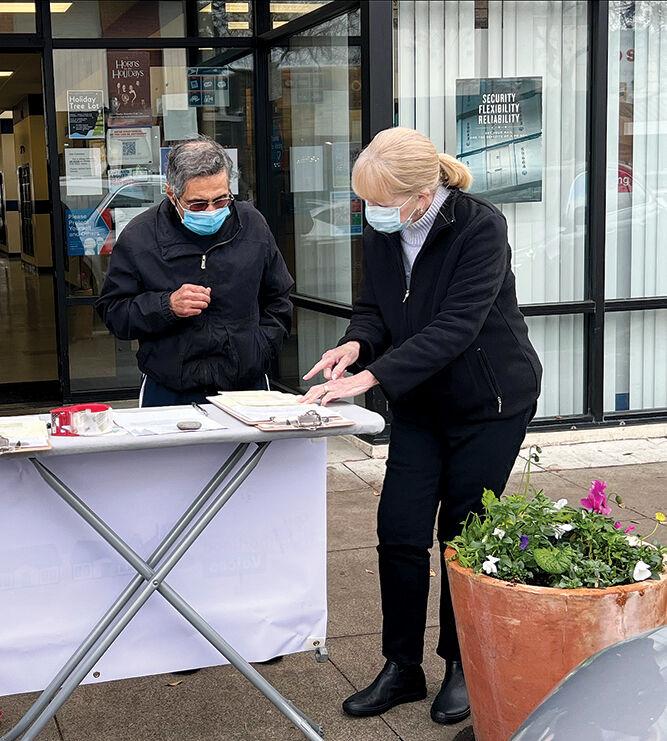
Also last week, local residents could be seen gathering signatures in front of the Los Altos post office on Main Street to get an initiative on the ballot in 2022 that would allow cities to override SB 9 and other laws that take away local control.
The residents’ advocacy group Los Altos Residents is helping gather the million-plus signatures needed for the initiative, intended to amend the State Constitution to give cities the option of using their own land-use laws.
“Give our city councils back the right to make decisions about what should be built in our neighborhoods,” the group urged.
source: https://www.losaltosonline.com/news/cities-react-fight-back-as-housing-law-nears/article_c9b11fda-61ef-11ec-b48c-43aabc474e95.html
Your content is great. However, if any of the content contained herein violates any rights of yours, including those of copyright, please contact us immediately by e-mail at media[@]kissrpr.com.