


District Attorney Says Law Enforcement 'Can't Just Pay Lip Service' To Communities - LevittownNow.com
Credit: Bucks County Community College/Screengrab
A discussion last week laid out how police and communities, especially those of color, can work together.
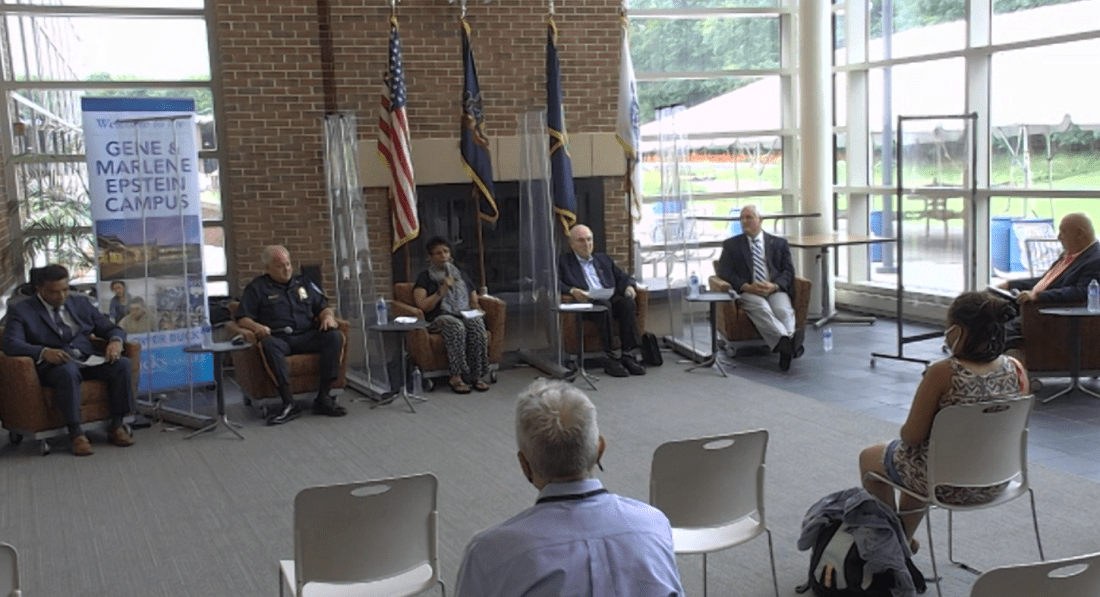
During a Constitution Day discussion at Bucks County Community College’s Epstein Campus at Lower Bucks in Bristol Township last Friday, representatives from law enforcement and the Bucks County National Association for the Advancement of Colored People (NAACP) discussed their collaboration.
The Bucks County NAACP has been meeting with county police chiefs in recent weeks to talk about building better relationships between the officers and residents.
It’s no secret that minority communities and police agencies don’t always have the strongest of bonds and efforts have taken place nationwide to strengthen those connections.
Bensalem Township Public Safety Director Fred Harran, a who is running as a Republican for county sheriff, said community policing efforts to build a stronger relationship between residents and police have only grown since he joined the Bensalem Township force in the 1990s.
Harran and Bucks County NAACP President Karen Downer explained how their two organizations work together.
Residents who want to make a complaint about police don’t have to make it directly to the department, which some people may find discouraging. They instead can make their complaint to a community leader or religious leader in their community, who then brings it to the police department, Harran and Downer explained.
The leader of Bucks County’s largest police department said his agency investigates complaints and brings in the NAACP to review them, as well.
“We’ve got nothing to hide,” Harran said.
Downer explained that police have let the Bucks County NAACP review body camera video.
Downer said a look at the evidence helps the group determine if the Bucks County NAACP is able to help the complaint take their dispute further.
Harran said members of the Bucks County NAACP and other community members sit in on oral boards as the department looks to hire new officers to get feedback.
The collaboration is part of an effort, according to Harran, to embrace the community and make them part of policing.
Despite the black eye given to some officers, Harran said the vast majority are doing the right thing.
“There are bad employees in every profession, and one bad doctor doesn’t stop people from going to the doctor,” Harran said.
District Attorney Matt Weintraub, a Republican running to remain the county’s top prosecutor, said the partnership between the Bucks County NAACP and Bensalem Township police is important.
“We can’t just pay lip service to the communities we serve,” he said.
Weintraub pointed to his row office’s effort to build lasting relationships with the community.
He also highlighted fact that the county’s roughly 40 local law enforcement agencies have adopted similar use-of-force policies, which are backed by best practices by outside groups.
The district attorney said he meets with the county’s police chiefs once a month and there are discussions about numerous issues.
Bucks County Human Relations Commission member Dr. Bernie Hoffman, a former Neshaminy School District administrator and discussion participant, pointed to the importance of police and community members collaborating.
When Hoffman was working at Neshaminy, he explained that Mike Chitwood, who served as Middletown Township’s police chief in the 1980s, often met with school officials and spoke with community members to bridge the department to the people it served.
Moderator Bill Pezza asked the panel about the term “defund the police.”
Harran and Weintraub agreed that the “defund the police” term was “terrible” and took away from the message of reform.
Harran pointed to the county-support co-responder program in Bensalem Township that has social workers respond with officers to help people who may need social services, like residents who are dealing with addiction, mental health issues, or aging.
The public safety director said co-responders help officers get back to handling traditional police responsibilities, while the co-responders get help for people who don’t need to an armed officer.
Downer said programs like the co-responder effort being piloted in Bensalem Township can be effective.
Weintraub and Harran said adding resources for programs, like the co-responder pilot, helps the community.
Bucks County Community College Diversity Officer Kevin Antoine, who also heads the Newtown Township Human Relations Commission, said people of color didn’t mean no money for law enforcement when they called for defunding the police, but, he explained, it meant scaling down some aspects of police departments and investing that money in other programs to help residents.
Pezza asked if Bucks County police departments are seeing problems retaining officers, which has become a problem in some cities.
Weintraub said that replacing officers leaving through attrition is a “real problem.”
“This is something we need to focus on,” he said, noting it will take years to get the next generation interested in policing as a career.
Harran said the problem of officers leaving early due to calls to change policing is more of a problem in cities and not suburban towns.
Antoine said the movement to reform policing gives a real chance to change recruitment and update the qualifications. He said that military veterans, like himself, could aid police departments by bringing more experience to forces.
source: http://levittownnow.com/2021/09/20/district-attorney-says-law-enforcement-cant-just-pay-lip-service-to-communities/
Your content is great. However, if any of the content contained herein violates any rights of yours, including those of copyright, please contact us immediately by e-mail at media[@]kissrpr.com.