


Expert panel reflects on Afghanistan's future at William & Mary Law School event | William & Mary - William & Mary News
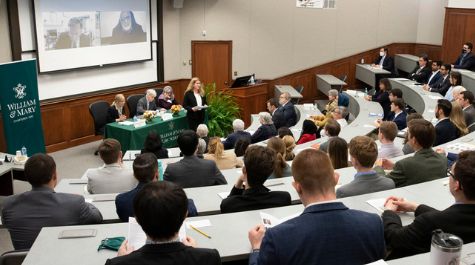
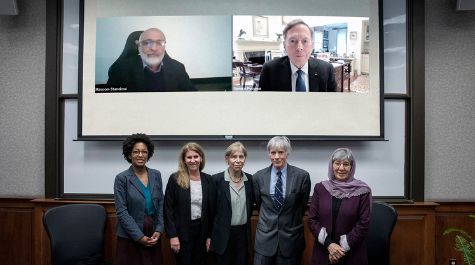
Professor Christie Warren introduces expert panelists at the March event: They included (via video, left to right) General David H. Petraeus, Mohammad Masoom Stanekzai and (seated, left to right), Alissa Johannsen Rubin, Ambassador Ryan Crocker and Dr. Sima Samar.
Hosted by the Center for Comparative Legal Studies & Post-Conflict Peacebuilding (CLS/PCP) the Reves Center for International Studies and the National Center for State Courts, the event featured a panel of distinguished military and diplomatic leaders, a senior war correspondent and two former Afghan ministers who offered analyses and candid reflections of their own decisions and actions over the course of what has been called by some a series of 20 one-year wars.
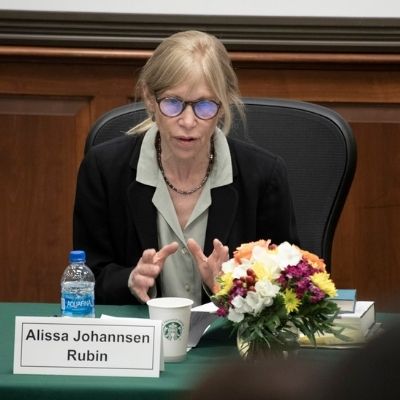
Alissa Johannsen-Rubin, former New York Times bureau chief in Kabul, Baghdad and Paris and recipient of the Pulitzer Prize for her coverage of Afghanistan, provided context to the discussion that followed by tracing the trajectory of Afghan history. She then asked fellow panelists Gen. David H. Petraeus, Ambassador Ryan C. Crocker, Dr. Sima Samar and Mohammad Masoom Stanekzai a series of probing questions about their own decisions.
Petraeus, who commanded U.S. forces in Afghanistan, called the eventual outcome tragic and heartbreaking, stating that the situation did not have to end the way it did. Citing significant mistakes made along the way and an outcome that paved the way for a return to extremism, his list of errors included the absence of strategic patience, the lack of a cohesive overall plan, a failure to allocate sufficient resources and ignorance of local dynamics and culture. Repeatedly confirming the United States’ intention to leave Afghanistan only empowered the Taliban and eliminated any political and military leverage we might have had, he said.
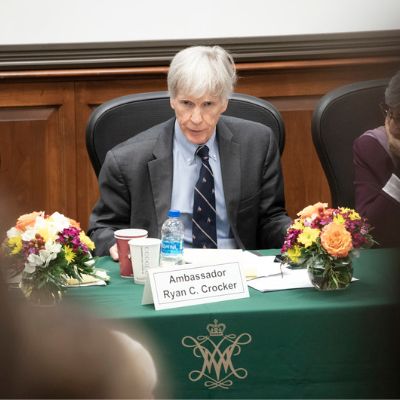
The assessment of Crocker, who served six terms as a U.S. Ambassador in the Middle East, was no more positive. Acknowledging that reconciling ideals and interests is often difficult, he stated that relinquishing America's agency to the Taliban resulted in a betrayal of its own values. He concluded with a warning that Ukraine will turn out to be a temporary distraction for the United States and that greater dangers are percolating in the Middle East as Pakistan, Iran, India and China evaluate their paths forward to fill the vacuum left by the U.S. withdrawal.
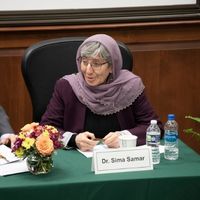
Afghan perspectives provided by Stanekzai, former chief of the National Directorate of Security and former chief peace negotiator for the Islamic Republic, and Samar, former minister of women’s affairs, mirrored those of Petraeus and Crocker. Stanekzai stated that inconsistencies in American strategies created space for corruption and organized crime and that the international community’s mission was flawed from the start when the Bonn talks failed to include all interested parties, including the Taliban. The failure to include women in the peace process led to their later exclusion from the government, Samar said.
The symposium may have raised many more questions than it answered, said Professor Christie S. Warren, director of the Center for Comparative Legal Studies & Post-Conflict Peacebuilding and chair of the symposium.
“These are exactly the types of issues that should be addressed within academic institutions,” she said. “Hard questions that aren’t addressed in the midst of conflict must be discussed afterwards in order to avoid replicating mistakes that risk sending the message that the United States is an unreliable partner and a power in decline.
source: https://www.wm.edu/news/stories/2022/expert-panel-reflects-on-afghanistans-future-at-william-mary-law-school-event.php
Your content is great. However, if any of the content contained herein violates any rights of yours, including those of copyright, please contact us immediately by e-mail at media[@]kissrpr.com.