


Former Polish president: ‘Restitution law isn’t against Jews" - The Jerusalem Post
Aleksander Kwaśniewski served as the President of Poland from 1995 to 2005. After the fall of Communism, he became a leader of the left-wing Social Democracy of the Republic of Poland.
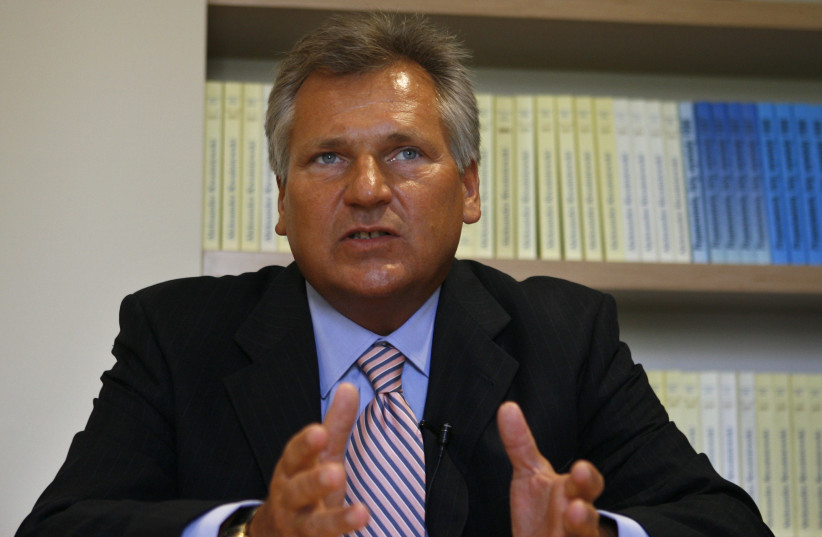
(photo credit: REUTERS/PETER ANDREWS)
“During the war, we were on the same side of history; Poles, Jews, Russians and Ukrainians - we were all occupied and killed by Nazis,” Former Polish president Aleksander Kwaśniewski said this week in an interview with the Jerusalem Post.
The former Polish politician visited Israel this week as a member of an international senior delegation on behalf of the Babyn Yar Holocaust Memorial Center where he is a member of the Supervisory Board.
Kwaśniewski admits that “of course, there were situations that some people were collaborating with Nazis, but it was not the majority; it was not a big group. Yad Vashem memorial decorated these people who were very helpful towards their Jewish neighbors.
“It is natural that each nation wants to see only these heroic pages in their history, but sometimes we have very tragic and bad pages or even shameful pages. And that is necessary to understand that history is complicated. I think after painful discussions we had in Poland, the public opinion was better with better self-understanding."
Aleksander Kwaśniewski served as the President of Poland from 1995 to 2005. After the fall of Communism, he became a leader of the left-wing Social Democracy of the Republic of Poland, a successor to the former ruling Polish United Workers' Party, and a co-founder of the Democratic Left Alliance.
In 2021, Poland enacted a law setting a 30-year time limit on appealing decisions made by special administrative bodies, effectively meaning that owners of property seized in the communist era can no longer receive compensation. The law sparked a diplomatic incident with Israel.
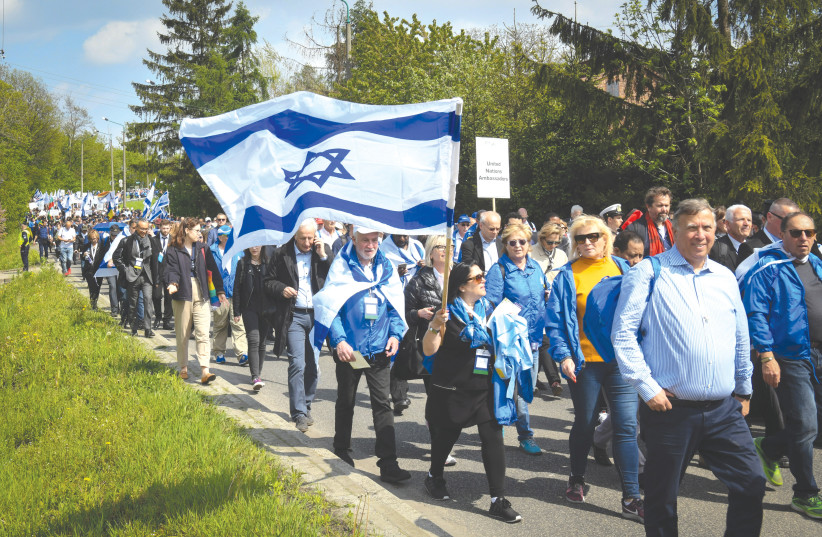
It seems the discussions regarding the restitution law have created a public opinion that strengthened the Polish nationalists. Therefore, the conflict with Israel escalated. Do you agree?
“No, no. I'll tell you what the difference is. I was very much involved in all these problems of restitution and reprivatization. Here is something I want to say to the Israeli public: This problem in Poland is very, very complicated, much more complicated than in Czech, Hungary or other countries. Why? Because Poland is the only country that changed borders so much after World War II. We lost 40 percent of our territory in the east; we have 30% new territory on the west - former German territories. Because of the Holocaust, we lost three million Polish citizens, Jews, that were Polish citizens. In addition, many cities and villages were totally destroyed. Warsaw was 80 percent destroyed. Other cities were 60 or 70 percent destroyed. Therefore, normal reprivatization is impossible.
“So for example, during my time as a president, we decided to give the possibility for Jewish organizations to restitute some buildings such as synagogues and Jewish Community Centers. But with private property, the situation is very complicated. Because the problem was not generally solved, we had a lot of crime connected with this, because reprivatization was possible legally through the courts. Unfortunately, some people have a huge imagination and they found some new ways how to use this situation for their own businesses.
“I think everything that the Polish government did in the last year wasn’t against Jews, it was not against Israel, it was how to make order with this situation.” Yet Kwaśniewski does have a bit of criticism towards the current Polish government. “The mistake was that this question was not sufficiently discussed and explained to our Israeli counterparts in parliament as well as Jewish organizations in the United States. It created, in my opinion, quite an artificial conflict, which was also exaggerated by the Israeli side. But this is an issue which we should have a very pragmatic way to solve, by having a good and close dialogue with our Israeli partners and Jewish organizations.”
So you agree with the law but you don't agree with the way it was managed externally?
The law is not against Jews. It’s against these mafia’s which started to do business with all this. For example, we had a situation where lawyers came on behalf of a lady who is 125 years old, you know, that's something that is problematic. So I think that this decision (the law) was created in order to stop this.”
What type of groups of Mafia are you talking about? Are they from around the world or from Poland?
“If there is a building in the center of Warsaw, for example, that is a good sell no? They generally are from Poland, but of course, connected with specialists that know what is needed in this process. It was a very domestic issue. Unfortunately, we managed it in a very bad way.”
You mentioned the Polish-Israeli tension as a “non-natural conflict”, yet here in Israel, it is perceived as a very intense and serious one. There were public figures that called for canceling high school trips to Poland - something that is very popular in Israel.
“No, this drama is wrong, because antisemitism exists in many places around the world. But I can tell you openly that in Poland that there still is a margin of antisemitism. I'm very much against this margin because knowing Polish history, it cannot be unacceptable. But still, Poland is very friendly, very open, and there is no reason to cancel any types of tourism, tours of students' visits, co-operation and more.
“Please understand: we have more Philo-Semites in Poland than antisemites. The Polish Philo-Semites admire Jews and are very interested in Jewish history. Also, we must remember that our common history goes back so many years. Frankly speaking, if an Israeli says that there is not one drop of blood in his body from Poland - he is mistaken. The same for a Polish man or woman that says there is not one drop of Jewish blood in their body. So please, if you have any influence, please say to all our Israeli partners: Let's continue the good cooperation with Poland because both sides need it.”
Kwaśniewski adds that he is “very happy” that there is what he calls “a renaissance of the study of Hebrew language. We have Hebrew faculties in many Polish universities,” he says happily.
The delegation members met this week with senior Israeli officials such as President Isaac Herzog, Speaker of the Knesset Mickey Levy, Foreign Minister Yair Lapid, Diaspora Affairs Minister Nachman Shai, Knesset Members and Chairman of Yad Vashem Dani Dayan.
The delegation members included Head of the Supervisory Board of Babyn Yar Memorial Natan Sharansky, Head of the Academic Council Father Patrick Desbois, Artistic Director Ilya Khrzhanovsky and Deputy General Director Ruslan Kavatsiuk.
Foreign Minister Yair Lapid told the delegation: "This project is of great importance to Ukraine and to the world, it is doing right with history and memory."
During the Second World War, about 6 million Jews died as a result of the Holocaust, of which 1.5 million people were killed on the territory of modern Ukraine. The Babyn Yar has become a terrible symbol of the "Holocaust by Bullets" in Eastern Europe. In just two days, September 29 and 30, 1941, the Nazis shot 33,771 Jews in the ravine. According to historians, during the Nazi occupation of Kyiv, from 1941 to 1943, from 70 to 100 thousand people were killed in Babyn Yar: Jews, Roma, Ukrainians, patients of the psychiatric hospital.
The Babyn Yar Holocaust Memorial Center is a non-governmental charitable organization dedicated to honoring the memory of the victims of the Babyn Yar tragedy and promoting humanization by preserving and studying the history of the Holocaust.
Kwaśniewski, who has initiated the establishment of the Polish Museum showing 1000 years of Jewish life in Poland, has in recent years served as a board member at the Babi Yar Holocaust Remembrance Center. He says that when the center is fully completed, it will play a significant role in Holocaust education and dialogue, as for the fight against antisemitism: "The establishment of the Holocaust Remembrance Center in Babi Yar is important for everyone: first and foremost for the victims of the Holocaust, for the Ukrainians themselves who, after 30 years of independence, can fully mature their history, the Jewish people and the whole world."
Kwaśniewski added that “establishing this memorial center is our moral obligation to the victims of the Holocaust, and it is an essential project for modern Ukraine.”
The former president concluded our conversation on a personal note, which he thinks is the example of why Jews and Israelis are so connected to Poland. “My grandmother was a great cook, and she made a few Jewish dishes. One of them was what we call Jewish Style Carp. When I first visited Jerusalem in 1987, I was at a restaurant and tried to explain what type of dish I was looking for. I said it's a bit sweet, and they finally understood and answered ‘Oh, you mean Warsaw Style Carp. That’s what we call it in Jerusalem’.”
There is one more dish that he still hasn’t found a good version of here in Israel. “My grandmother used to make us Cholent. When I came to Israel in the 80’s I looked for this dish everywhere. When I finally found a restaurant that served it, I was a bit surprised - it tasted very different. I still prefer my grandmother's interpretation of it,” he says with a big smile.
Kwaśniewski also addressed the Conference of Presidents of Major American Jewish Organizations in Israel, and spoke about the current situation of Ukraine.
source: https://www.jpost.com/diaspora/article-698239
Your content is great. However, if any of the content contained herein violates any rights of yours, including those of copyright, please contact us immediately by e-mail at media[@]kissrpr.com.