


Local Leaders Applaud Removal of ADU Law | Somers, NY News TAPinto - TAPinto.net
WESTCHESTER, N.Y. - Local officials last week hailed Gov. Kathy Hochul’s decision to remove accessory dwelling units (ADU) legislation from her Executive Budget for 2023.
Critics had passionately argued it would remove home rule from zoning decisions.
Hochul explained the reversal Thursday, Feb. 17, saying that she’s always “believed strongly in the importance of consensus-building and listening to communities and my fellow policymakers.”
There were two sections of the Education, Labor, and Family Assistance bill (S.8006/A.9006) that were ensconced in the 2023 spending plan.
The first, the Accessory Dwelling Act of 2022 (ADU), was sponsored by State Senator Peter Harckham (D-Lewisboro) and Assemblyman Harvey Epstein of Manhattan.
It mandated that local governments authorize the construction of accessory dwelling units – including in attics, garages, basements, and backyard cottages – by local law and impose state reporting, regulatory, and enforcement requirements. The budget set aside $85 million to support the creation and rehabilitation of said units.
Local officials are also worried about another part of Hochul’s plan that is apparently still included — the Transit-Oriented Development Act of 2022 (TOD).
That would amend general town law, requiring local governments to authorize the construction of up to 25 residential units per acre within a half-mile of transportation centers, such as a train or bus station. There was no funding component to that in Hochul’s budget.
“I have heard real concerns about the proposed approach on accessory dwelling units and transit-oriented development, and I understand that my colleagues in the state Senate believe a different set of tools is needed, even if they agree with the goal of supporting the growth of this kind of housing,” the governor said Thursday.
Other less controversial proposals included in Hochul’s overall plan will, if enacted into law, ease restrictions on commercial and hotel conversions to residential units, remove the FAR (floor-area ratio) cap in New York City, and improve the “421-a” program that provides partial real estate tax exemptions for the new construction of multi-family rental housing. She claimed that it could help create up to 10,000 “units of supportive housing.”
Hochul had said the idea behind the ADU provision was partly to bring up to code illegal and unsafe apartments in single-family homes.
Referring to the deaths of 11 people who were trapped in illegal basement apartments flooded by Hurricane Ida last year, Hochul had said that she and New York City leaders “agree that we must begin to bring these homes into the sunlight and provide a pathway to compliance with building code requirements.”
The ADU proposal had been roundly denounced by both Democrats and Republicans.
The most notable critic was Congressman Tom Suozzi, a former Nassau County executive who is planning to challenge Hochul’s gubernatorial bid in the Democratic primaries. On Saturday, Feb. 12, he and a group of Westchester municipal leaders – including Yorktown Supervisor Matthew Slater and North Salem Supervisor Warren Lucas — rallied in Chappaqua.
Suozzi called taking any kind of home rule away from local officials “undemocratic” and “inappropriate.”
Hochul asserted Thursday that she still felt that the “larger conversation about accessory dwelling units across the state must not prevent critical progress in New York City from moving forward.” The amended bill will still allow the city to legalize ADUs.
She added that she was amending her budget to remove the ADU legislation “in order to facilitate a conversation about how we build consensus around solutions.”
Harckham, saying Friday, Feb. 18, that he understood Hochul’s decision to remove the ADU initiative from the Executive Budget, noted that the action “highlights our primary concern, which is to get all of the details of the bill right, rather than enact a bill right away.”
Promising that he will “continue to engage with stakeholders and work to settle all concerns with this legislation, the lawmaker added that it was “important that we keep driving a conversation, however, on affordable housing for our workforce and equitable treatment for our residents.”
Pushback from both Democratic and Republican local officials across the state ramped up in recent weeks as Albany’s budget clock ticked down to the April 1 passage deadline. In a strongly worded memo, the New York State Conference of Mayors and Municipal Officials had argued that eroding home rule would likely result in “disjointed development that is out of character with a community’s desires.”
Harckham and Epstein rebutted that, saying the law would not end local control over single-family and multi-family housing.
“In fact, local governments are asked to come up with a proposal for including ADUs in their planning, so that consideration can be given on a case-by-case basis to the needs of each community,” according to Harckham’s office.
The Somers Town Board on Thursday, Feb. 10, had passed a resolution expressing its fervent opposition to both the ADU and TOD measures.
Reacting to Hochul’s decision to withdraw the controversial proposal, Supervisor Robert Scorrano said Saturday, Feb. 19, that “from the outset, this was an overreach by Albany politicians.”
Scorrano added that he was proud that Somers “stood up for home rule with colleagues from Westchester on both sides of the aisle and the message sent was loud and clear.”
Noting that Somers already has legislation in place for accessory dwelling units, Scorrano stated that the town “has done more to address affordable housing than asked to do.”
According to a statement sent to Somers residents, the town has “addressed” accessory dwelling units in its code since 1934. It also, it claimed, has handled the affordable housing issue so well that last July Westchester County Executive George Latimer praised the Town Board and former Supervisor Rick Morrissey for doing its part “when it came to affordable housing.”
The county “wanted 750 units across all municipalities. Somers contributed 167 units – that’s 22 percent,” it said.
The main argument folks have been making is that “it is not one size fits all piece of legislation.”
There would be significant consequences, foes of the legislation claimed, including impacts on local police, fire departments, schools, parks, traffic, water, and so on.
“We understand what’s best for Somers, not bureaucrats in Albany,” Scorrano concluded Saturday.
Hochul’s decision to take the ADU legislation out of the budget shows, he had said earlier last week, that she had “listened to people around the state.”
North Salem was expected to discuss a similar resolution denouncing the ADU legislation on Tuesday, Feb. 22, although its wording will be different now that the proposal is officially out of Hochul’s budget. It could not be determined at press time if the resolution would also tackle the TOD issue.
Lucas said Friday, Feb. 18, that he remains adamantly opposed to “any zoning legislation that comes from the state that flies in the face of the Constitution.”
North Salem currently has 265 ADUs, as well as Bridleside, a 64-unit affordable apartment complex. The area of town that could be the most impacted by the TOD proposal is Croton Falls. Not only is its downtown surrounded by single-family homes, there is a Metro-North parking lot under construction within walking distance of the hamlet’s train station. At three or four acres, and 25 units an acre, there could be dozens of housing units built there.
There’s been “a lot of pressure” surrounding the affordable housing issue, but Lucas said he and other local government officials don’t plan to stand down on what he called “just terrible” legislation.
“It negates home rule, and it’s critical it stays out,” he said, explaining that “there’s no way they can put a bill together that properly and effectively defines code for the entire state of New York.”
Just because it has been removed from the Executive Budget — and likely the Assembly/Senate spending plan — doesn’t mean that an amended ADU bill can’t reemerge this year. Opponents, such as Lucas, have vowed to keep the pressure on until the legislation is truly defunct.
Calling the ADU legislation “dangerous and ill-thought,” Slater on Sunday, Feb. 20, called Hochul’s decision to remove it from her budget “a great victory for communities across New York state.”
“A bipartisan coalition of municipal officials including the Yorktown Town Board worked tirelessly to stop this proposal and stand up to an egregious overreach by Albany politicians,” he said, adding that the town supports accessory dwelling units and “has produced 177 to date.”
“We clearly don’t need Albany telling us how to produce accessory dwelling units,” Slater declared.
He urged municipal officials to focus their “collective energies” on defeating the governor’s Transit Oriented Housing proposal, calling it “an equally alarming and precedent-setting policy that will undoubtedly alter the character of municipalities across New York state.”
Bedford Supervisor Ellen Calves, while applauding the legislation’s goal of increasing the affordable housing stock, still had called for changes to safeguard “certain things that we control and want to continue to control.”
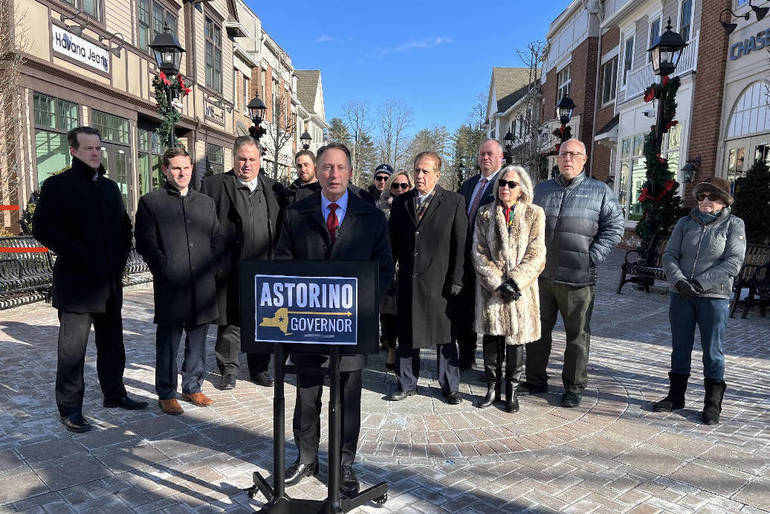
Scorrano, Lucas, Slater and a bipartisan group of pols joined Republican gubernatorial candidate and former Westchester County Executive Rob Astorino in Armonk on Monday, Feb. 14, to publicly denounce the legislation as an attempt to override home rule.
Also reacting to Hochul’s decision Friday, Assemblyman Chris Burdick (D-Bedford) said he believed “accessory dwelling units can be a very good tool for increasing the supply of housing units.”
Burdick, who has represented the 93rd District since January 2021, previously served as Bedford town supervisor. He is a member of the Assembly’s Housing Committee.
While expressing “great respect” for Harckham, he still didn’t think “this was the way to do it.”
“I think that some people are going to declare victory and say the Big Bad Wolf is dead, but I don’t really look at it that way. I look at it as a process that can return to a less-pressured discussion of how can we move things forward.”
source: https://www.tapinto.net/towns/somers/sections/government/articles/local-leaders-applaud-removal-of-adu-law
Your content is great. However, if any of the content contained herein violates any rights of yours, including those of copyright, please contact us immediately by e-mail at media[@]kissrpr.com.