


Tesla And The Law Of Accelerating Returns - Seeking Alpha
Summary
- Elon Musk's embrace of Kurzweillian philosophy sets Tesla apart from the rest of the industry.
- It is impossible to understand Tesla's decision-making without knowledge of exponential technology trends.
- Tesla is taking advantage of the changing dynamics in business economics.
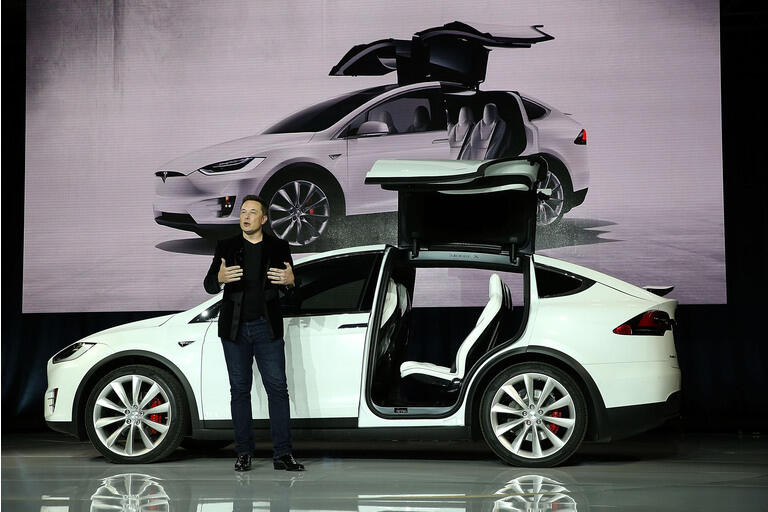
Justin Sullivan/Getty Images News
Tesla (TSLA) is arguably the most polarizing company in existence today. To some, Tesla is an unprecedented technological powerhouse led by a visionary the likes of which the world has never seen. To others, Tesla is a giant house of cards run by a charlatan. The evidence as of late would seem to suggest that the former is more likely to be true.
Although many would still vehemently disagree with this statement, even die-hard bears will have to concede that Tesla is at least performing far beyond expectations. With that being said, it is still anyone's guess how Tesla will perform in the near term. However, I believe that Tesla will vastly outperform long-term expectations given a few key advantages that are seldom mentioned.
Elon Musk's Embrace of Kurzweillian Philosophy
Ray Kurzweil is arguably the world's most famous and influential futurist. The man has almost single-handedly popularized concepts such as the technological singularity, which sparks fierce debate even among the most accomplished and learned technologists. Ray Kurzweil's philosophies are primarily predicated on the exponential nature of technologies.
The logic behind the Kurzweillian philosophy goes something like this: Technology allows for an increased rate of technological innovation. The new technologies that emerge further push the rate of innovation and thus the process accelerates. This "Law of Accelerating Returns," as Ray Kurzweil coins it, allows for exponential technological change, particularly in semiconductor-based industries.
Elon Musk, as it turns out, has made it incredibly clear that he agrees with the general principles behind Kurzweillian philosophy. His alignment with such ideas is further evident in longer sit-down interviews with the likes of Joe Rogan or Cathy Wood. This is incredibly important to note as Tesla cannot be properly analyzed without having this in mind. By all indications, this philosophy is one of the major drivers behind Musk's long-term decisions and vision of Tesla.
Most mainstream Tesla analysts have likely never even heard of Ray Kurzweil. They may have heard terms such as "exponential technological progress" thrown around in passing but likely have never delved deeply into the reasoning behind such concepts. It is for this reason that many analysts believe that Elon Musk is far too optimistic or even outright fraudulent when he makes his seemingly outlandish predictions about Tesla.
After all, those who take a traditionally linear view of technological progress will have wildly different projections compared to those who hold an exponential view of technological progress. This explains why the vast majority of financial analysts believe Tesla is incredibly overvalued and why a large percentage of Silicon Valley technologists believe Tesla has the potential to be orders of magnitude larger than it is today. The almost-comical divergence of opinions on Tesla makes complete sense in this light.
Source: Kurzweil AI
The Power of Exponentials
It is impossible to have a good understanding of Musk's decision-making at Tesla without knowledge of broader concepts espoused by Kurzweil. For instance, much of Musk's decision-making when it comes to self-driving technologies stems from a belief that compute power and neural nets will continue to improve at an exponential rate.
In fact, Tesla's decision to transition away from lidar to vision-only is a testament to Musk's belief in the exponential power of semiconductors and AI. At today's standards of technology, neural nets are still far off from achieving full self-driving, especially when using vision-only technologies. However, if one buys into the idea that chip and AI technologies will improve at an exponential rate, full self-driving may be achieved far quicker than most imagine.
Here is a common example used to illustrate the power of exponentials: Imagine a man has a stride equivalent to 1 meter in length. By 30 strides, the man would have walked ~30 meters. However, if that man were to double the length of his stride every stride he took, the man would have walked ~1 billion meters by his 30th stride.
The same principle can be applied, although to a lesser degree, to technologies like full self-driving. While it is easy to imagine full self-driving taking decades to achieve when modeling progress using a linear formula, full self-driving may only be a few years away when modeling progress using an exponential formula. It is for this reason why one individual can watch a Tesla FSD video and think that full self-driving will not be achieved in his/her lifetime, whereas another individual may watch the exact same video and conclude that full self-driving is only a few years away.
Musk's belief in vision-only full self-driving illustrates his belief in exponential technological progress.
Source: Tesla
Which Side is Right?
The "law of accelerating returns" applies more to semiconductor-based technologies than anything else. If computer hardware and software continue to improve at an exponential rate, the car company with the most advanced chip technologies and AI, namely Tesla, will have a good chance of accelerating its lead.
The major long-term differentiator in the automotive space will likely be software-related technologies like full self-driving. It should be far easier for Tesla's competitors to catch up on the manufacturing front, especially as Tesla lays the groundwork and blueprint for newer EV manufacturing technologies and techniques. Although Tesla could conceivably maintain its manufacturing lead for the foreseeable future, competitors will likely close the gap on this front quicker than they could on the software front.
Much of the bull thesis surrounding Tesla hinges on continued exponential advancements in computing and AI. Ultimately, it is anyone's guess how rapidly such technologies will advance in the future. Although Moore's law has held true for decades now, the industry may be witnessing a breakdown of Moore's law as chips start to reach the low-single-digit nm process range.
At this point, however, Tesla may have already established an insurmountable lead on the software front given its massive and growing data lead. Given that neural nets feed on data, Tesla is already experiencing a runaway flywheel effect where its growing customer base is making its software better by feeding Tesla's neural nets more data. This in turn drives up sales even higher as a result of data-driven software improvements.
Because of this flywheel effect, Tesla could very well accelerate its lead even if neural nets are not able to accomplish full self-driving in the foreseeable future. As long as Tesla's full self-driving software is superior to those of its competitors, the company will likely command higher sales and/or margins. At the end of the day, it may not even matter if advancements in computing and AI slow down considerably. Tesla has already established an insurmountable data lead on its competitors.
Rarely Mentioned Talent Acquisition Advantage
Musk's embrace of futurism has allowed him to push Tesla far beyond what most thought was possible in the automotive industry. In fact, Tesla is rapidly building a reputation as a leading technology company despite the insistence of many that Tesla is still just a car company. Tesla has now achieved a reputation of achieving extraordinary technological feats.
In light of all this, it is not altogether unsurprising that US engineering students now rank Tesla as the second most attractive company to work for according to a 2021 report. In fact, only Musk's Space X beats Tesla on this front according to the report. This alone gives Tesla a massive advantage over its competitors, especially as competition for talented engineers will only intensify with the electrification of the automotive industry. Tesla is also ranked 3rd and 4th among business/commerce and computer science graduates respectively.
Musk's ability to convincingly sell a fantastical vision of the future has undoubtedly helped Tesla attract more and more talent. Although Musk has often been lambasted for his over-optimistic predictions and timelines, it is this optimism, which is likely driven by Musk's sincere belief in the continued exponential progress of technology, that allows Musk to push Tesla beyond traditional limits in the automotive industry. Tesla's major competitors do not even make the top 10 list among engineering students, let alone in fields like computer science.
Tesla's ability to attract top-tier talent is one of the company's most underrated traits.
Traditional Business Principles Break Down in Tesla's Case
The majority of Wall Street analysts and investors believe that Tesla is far too overvalued. After all, Tesla is an automotive company with a seemingly absurd forward PE ratio of ~186 at its current valuation of $1.15 trillion. Nothing in traditional finance or economics textbooks would indicate that Tesla is even remotely a solid long-term investment. Even the few that recommend buying Tesla often view Tesla as a short-term, momentum play.
I would argue that the Tesla bear position is the far easier position to take. Most analysts are not taking into account how many traditional business and economic principles are breaking down in the face of emerging technologies like AI and even social media. There are no textbooks discussing how AI and software completely change the dynamics of automotive manufacturing or how Twitter is worth countless billions of dollars in traditional marketing.
Tesla is leveraging emerging technologies like AI even in its workforce. According to a former Tesla employee, Tesla heavily incorporates AI even into daily operations, which allows for a flatter corporate structure with less bureaucracy. In fact, Tesla's corporate structure is so flat that factory floor employees often have direct access to Elon Musk. Roles that have traditionally been filled by middle management can increasingly be filled by AI. This means that the organizational diseconomies of scale faced by traditional large corporations do not apply as much in Tesla's case.
In addition, the emergence of social media itself has broken down the traditional economics associated with marketing. Not only has Tesla embraced social media marketing, but it has arguably utilized social media far better than any company in existence today. Of course, having a CEO with one of the world's largest social media followings and absurdly high engagement numbers help tremendously.
Musk's social media presence and savvy itself create a flywheel effect for Tesla. Musk can promote Tesla's products to hundreds of millions of people at no cost with a single tweet and achieve levels of virality that are impossible to replicate with traditional marketing. Such virality inevitably leads to greater sales, which in turn allows Tesla to focus even more resources on product development.
Musk has created a first-mover advantage of sorts on the social media front. Musk is arguably the first CEO of a major corporation to build a massive social media presence through a combination of wit, humor, and oftentimes outrageous tweets. Musk is now almost able to monopolize attention on social media platforms and even traditional media outlets like CNBC for short periods of time with a single tweet.
Even though many of Musk's tweets are not directly related to Tesla, the fact that Musk is able to garner so much attention for himself ultimately helps Tesla in the long run as Musk is so deeply tied to the Tesla brand. Musk and Tesla's large social media presence is ultimately another barrier to entry for competitors. A hypothetical Tesla competitor with the exact same technology and product pricing as Tesla will still be at a major disadvantage on the sole basis of social media presence alone.
These new business realities brought about by emerging technologies have yet to be fully factored in when it comes to most Tesla valuation models. This also partly explains why most analysts not named Cathy Wood consistently underestimate Tesla to a large degree. Either Tesla is performing miracles quarter after quarter for more than a decade, or the entire Tesla bear model formulation is fundamentally flawed.
Major Challenges and Risks Remain
Despite Tesla's growing lead in the EV space, the company by no means has a clear path ahead. Tesla is venturing into unexplored territory with its massive Berlin and Austin factories coming online. Not only are these factories expected to operate at a scale unseen in the entirety of industry, but they will also utilize newer manufacturing techniques and technologies like the Giga Press and the 4680 battery cell. Underperformance on any of Tesla's new technologies and manufacturing techniques could mean billions of dollars wasted for the company.
The degree at which Musk pushes Tesla and his general overoptimism also pose some serious risks to Tesla. Although Musk's relentless drive and optimism have clearly benefited Tesla on balance, these traits also have the potential to derail the company to varying degrees. Committing so heavily to Gigafactory Berlin without full approvals, for instance, has resulted in numerous month-long delays.
Another example of Musk's overoptimism was his reported insistence that the Model Y did not need a steering wheel. According to Tim Higgins' book "Power Play: Tesla, Elon Musk, and the Bet of the Century," Tesla's engineers actually had to develop the steering wheel behind his back. If true, this is perhaps the most glaring example of Musk's overoptimism nearly backfiring. A Model Y with no steering wheel would have been disastrous for Tesla, especially considering how far off full self-driving was when the Model Y first debuted.
Musk's social media presence is also not all positive. He has shown a penchant for firing off tweets that have no redeeming qualities in terms of bolstering Tesla's brand or sales. In fact, many of Musk's tweets are outright damaging to Tesla no matter how they are spun.
Conclusion
Tesla's market capitalization of $1.15 trillion makes no sense when using traditional valuation methods. However, Tesla's unique position as a technology disruptor and pioneer makes such traditional valuation methods obsolete. Can anyone seriously compare Tesla's financials to those of other car manufacturers when it is completely disrupting the entire industry, while at the same time reaching margins unheard of in the industry?
How exactly does one accurately value Tesla when the company has a real chance of dominating the full self-driving market, which some estimate will reach nearly $10 trillion by 2030? Even if ride-hailing costs were to drop significantly as a result of self-driving, the market would still be worth trillions of dollars. Of course, all of this is predicated on Tesla achieving full self-driving within the next decade.
Even still, most analysts should at least factor in aspects like full self-driving in their Tesla valuation models. Even some of the more bullish valuation models do not account for full self-driving at all, which essentially means they are giving Tesla a 0% probability of achieving full self-driving within the timeframe of their models.
Given the technological, infrastructure, resource, marketing, and talent advantages that Tesla holds, it is hard to even imagine how any of its competitors can catch up. Tesla has a real chance at achieving long-term dominance and unprecedented margins in many multi-trillion-dollar markets. Looking at Tesla through this lens, Tesla looks like a bargain at $1.15 trillion.
Disclosure: I/we have a beneficial long position in the shares of TSLA either through stock ownership, options, or other derivatives. I wrote this article myself, and it expresses my own opinions. I am not receiving compensation for it (other than from Seeking Alpha). I have no business relationship with any company whose stock is mentioned in this article.
source: https://seekingalpha.com/article/4473771-tesla-tsla-stock-and-law-of-accelerating-returns
Your content is great. However, if any of the content contained herein violates any rights of yours, including those of copyright, please contact us immediately by e-mail at media[@]kissrpr.com.