


Updated data from law enforcement contact study shows people of color are more likely to be searched by police at night - Lawrence Journal-World
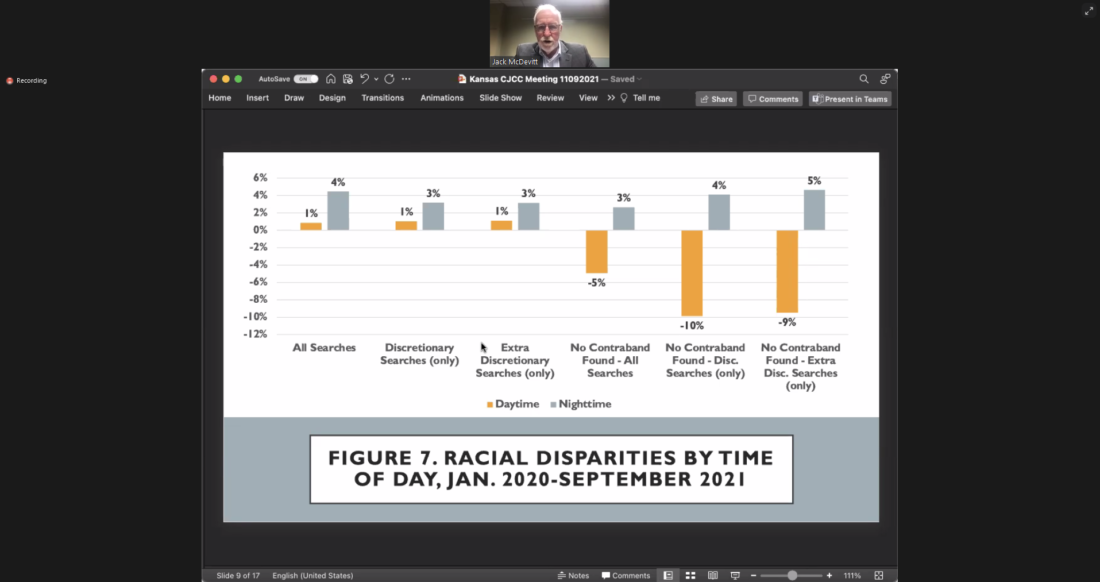
photo by: Meeting screenshot/CJCC
People of color in Douglas County who come into contact with law enforcement officers at night are more likely to be searched, according to updated findings of a local law enforcement contact study.
But when it comes to police issuing citations to individuals in Douglas County, the findings show no racial disparities.
“At this point, the simple lesson is that there is some good news here and there is also a bit of troubling news,” said Charles Epp, a member of the Douglas County Criminal Justice Coordinating Council.
Researchers Jack McDevitt, of Northeastern University, and Janice Iwama, of American University, presented the new data to the CJCC on Tuesday.
One of the new statistics available was the racial breakdown of searches at different times of day. According to that data, people of color in Douglas County are 4% more likely than white people to be searched at night. But during the day, people of color are just 1% more likely to be searched.
McDevitt said the data was just a starting point where local law enforcement agencies could look for possible discrimination and ways to improve their practices. For example, he said that law enforcement agencies could look at the data about searches at different times of day and consider giving officers more training or reevaluating how they conduct searches at night.
He also said the fact that there are racial disparities didn’t necessarily mean that officers were discriminating against people of color.
The day and night disparities weren’t the only areas that could use more scrutiny, McDevitt said. He also said law enforcement agencies should pay attention to the reason they stop drivers.
Compared to national trends, Douglas County law enforcement officers generally stop individuals less often for speeding or other traffic violations, according to the data that was shared with the CJCC. However, they are more likely than the national averages to stop individuals for equipment or inspection violations, such as pulling someone over for a broken taillight.
McDevitt said that is something to keep an eye on because those types of stops are “generally discretionary,” meaning they could provide an opportunity for bias.
“It’s one of the areas where people are concerned police might be engaging in stops as a pretext to look for other things,” he said. “This is something that bears paying attention to.”
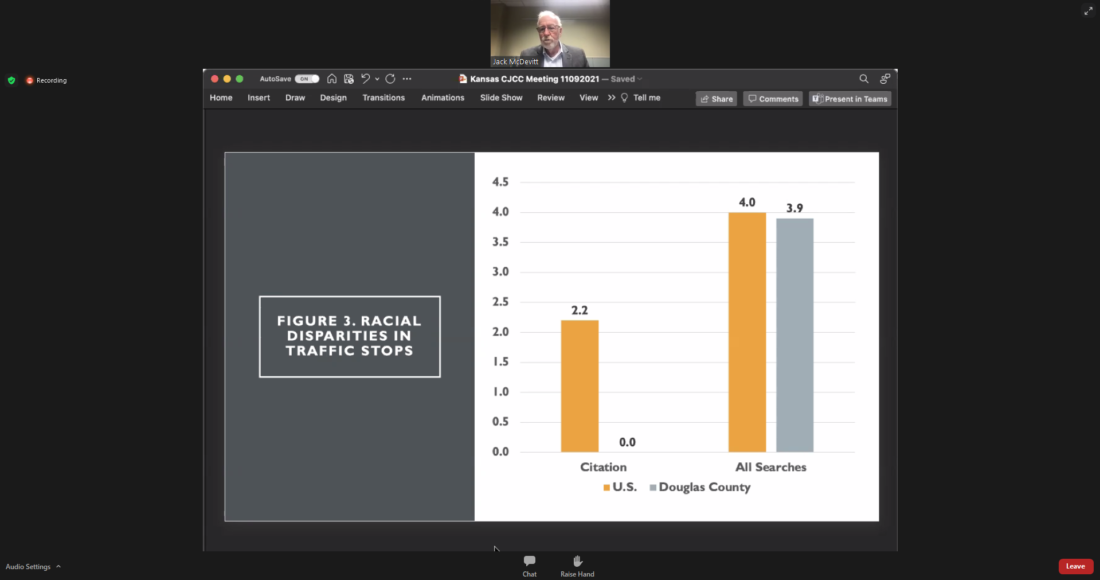
photo by: Meeting screenshot/CJCC
But there was also some good news: McDevitt said that people in Douglas County who are stopped by police are more than twice as likely to get a warning as opposed to a citation.
Additionally, Douglas County does not have a racial disparity among people who receive citations. McDevitt said that nationwide, people of color who are stopped by police get citations 2.2% more often than white people, while Douglas County’s difference is zero. Iwama said 22% of both people of color and people who are white who are stopped by police are issued a citation in Douglas County.
“The chance of getting a citation is exactly equal in Douglas County,” McDevitt said. “That’s the good news and what everybody wants.”
But the disparity still exists in police searches, and McDevitt said it mirrors the national average. The new data showed that in Douglas County, people of color are about 3.9% more likely to be searched than white people, which is in line with the national average of 4%.
While acknowledging the data showing no racial disparities among citations, council member Mariel Ferreiro said she is still concerned about the data related to searches of people of color.
“Even though there are good pieces and clarifying information that we are not being completely discriminatory in our policing, there is still that very real piece of it that there are still searches that are happening that, in my opinion, are very much racially motivated,” she said.
This isn’t the first set of statistics that the CJCC has heard from the researchers. In August, the researchers shared some preliminary findings that showed people of color in Douglas County were almost twice as likely as white people to be searched by police, the Journal-World reported. It wasn’t clear how the data shared Tuesday was related to the data that was shared in August.
The contact study will continue into the fall and the researchers are expected to provide a final report with recommendations based on the data in the spring.
Contact Dylan Lysen
Have a story idea, news or information to share? Contact reporter Dylan Lysen:
COMMENTS
Welcome to the new LJWorld.com. Our old commenting system has been replaced with Facebook Comments. There is no longer a separate username and password login step. If you are already signed into Facebook within your browser, you will be able to comment. If you do not have a Facebook account and do not wish to create one, you will not be able to comment on stories.
Public Safety
Updated data from law enforcement contact study shows people of color are more likely to be searched by police at night
Lawrence police blotter for Nov. 9, 2021
Eudora man killed in single-vehicle wreck in Leavenworth County
A 32-year-old Eudora man was killed in a single-vehicle wreck, in which the vehicle became engulfed in flames, in ...
Kansas capital punishment abolitionist: ‘We aren’t good enough to kill people’
Lawrence police blotter for Nov. 8, 2021
Person in west Lawrence home shot after ‘negligent discharge’ while handling gun
source: https://www2.ljworld.com/news/public-safety/2021/nov/09/updated-data-from-law-enforcement-contact-study-shows-people-of-color-are-more-likely-to-be-searched-by-police-at-night/
Your content is great. However, if any of the content contained herein violates any rights of yours, including those of copyright, please contact us immediately by e-mail at media[@]kissrpr.com.