


Youngkin's motion to dismiss lawsuit challenging mask-optional law says parents' claims about disabled kids are 'speculative' - Prince William Times
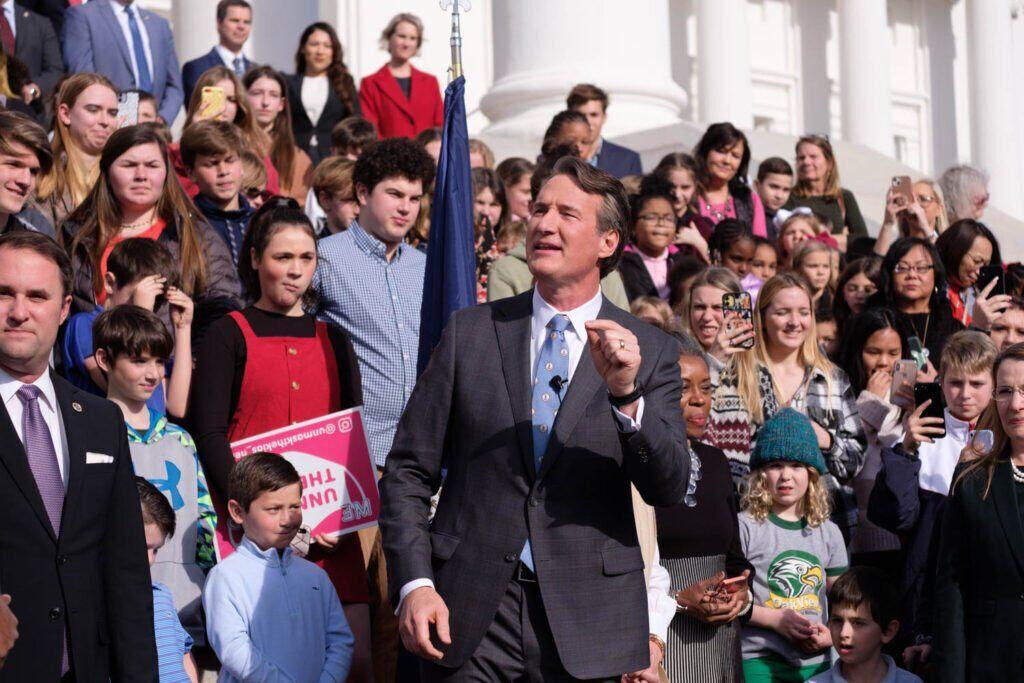
Ahead of a hearing in federal court set for Monday, Gov. Glenn Youngkin’s administration has filed a motion to dismiss a federal lawsuit challenging the state’s mask-optional rules brought by 12 Virginia parents of students with disabilities that put them at a high risk for complications due to COVID-19.
The 41-page motion, filed Monday, Feb. 28 by Virginia Attorney General Jason Miyares (R) on behalf of the Youngkin administration, argues that Youngkin’s Executive Order 2 and Senate Bill 739, both of which effectively ban mask-mandates in Virginia’s public schools, should be upheld because neither contradicts federal law and because the parents lack standing to bring their claim.
State Solicitor General Andrew N. Ferguson penned defendants’ brief asking the federal court to dismiss the plaintiffs’ claims in full.
Manassas mom Tasha Nelson, whose 10-year-old son has cystic fibrosis, and 11 other Virginia parents are suing Youngkin to challenge the new state law and his EO, saying they violate the Americans with Disabilities Act and Section 504 of the Rehabilitation Act. Both federal laws say public schools cannot exclude students with disabilities or deny them equal access to their education. The laws also require public schools to provide reasonable modifications to allow students with disabilities an equal opportunity to benefit from their public education.
In the motion to dismiss the case, Ferguson argues the parents have not established that the mask-optional law and EO violate those federal laws, arguing that “[S]tudent mask mandates are not a reasonable accommodation under the ADA or the Rehabilitation Act.”
The motion also says the plaintiffs have not demonstrated that “a mask mandate would be the only way to provide plaintiffs an in-person public education.”
Nothing in the new state law or EO prevents plaintiffs and their school districts from engaging in “alternate strategies to reduce their risk of contracting COVID-19, apart from mandating that all other students wear masks,” the motion states.
Instead, Youngkin’s motion offers the following possible alternate accommodations: masking requirements for teachers or staff when in close proximity to the plaintiffs’ children, physical distancing from unmasked students, classmates voluntarily masking, improved ventilation, or distance learning when appropriate.
The motion also argues the Virginia parents should not have sued Youngkin in federal court because they did not “exhaust administrative remedies before litigating ADA and Rehabilitation Act claims,” meaning that they should have requested accommodations from their schools instead of bringing a lawsuit.
Ferguson’s motion also argues the parents lack standing – the ability to bring their case –
because “the challenged provisions have not injured” plaintiffs’ children because the alleged injuries are either “speculative” or “self-inflicted.”
In their lawsuit, filed in federal court in Charlottesville last month, the parents argue school divisions should have the authority to require masking when needed to ensure that children who are at a greater risk of severe complications from a COVID-19 infection have equal access to their education.
Specifically, plaintiffs contend that school districts have an obligation to require universal masking under the ADA when they have students with disabilities who require universal masking to remain learning in the classroom.
“Defendants’ briefing mischaracterizes our demand,” said Eve Hill, one of plaintiffs’ attorneys. Hill is a partner at Brown Goldstein & Levy and is one of the nation’s leading disability rights attorneys. “They argue that we are asking for masking of all students all the time, indefinitely. That is incorrect.”
Hill said that the plaintiffs’ lawsuit is asking that “school districts be allowed to respond to the needs of students with disabilities, which may range from no need for masks to a need for masks in a particular classroom or activity, to masking when kids are near the high-risk student, to universal masking.”
Finally, Youngkin’s motion to dismiss the case implores the court to find that overturning EO 2 and SB739 is not in the public interest because “student mask mandates are no longer generally recommended by the CDC and are detrimental to many children’s academic, social, and emotional development, and to their mental health.”
The motion also makes the claim that siding with the plaintiffs would harm the public interest. “Parents should be able to decide whether their children should continue to wear masks at school, and children should not be punished or removed from their classrooms on the basis of those choices,” according to Youngkin’s motion.
The plaintiffs say allowing school districts to require masking when needed is in the public interest.
“Our solution would also allow schools to respond to outbreaks in school, future surges, and students who return from quarantine early and should mask but refuse to do so. In the absence of the ability to impose mask requirements, their only options will be to let COVID run wild or close their doors again,” Hill said.
source: https://www.princewilliamtimes.com/news/youngkins-motion-to-dismiss-lawsuit-challenging-mask-optional-law-says-parents-claims-about-disabled-kids/article_f9fb4e94-9b11-11ec-8bed-a386ecb1b7b4.html
Your content is great. However, if any of the content contained herein violates any rights of yours, including those of copyright, please contact us immediately by e-mail at media[@]kissrpr.com.